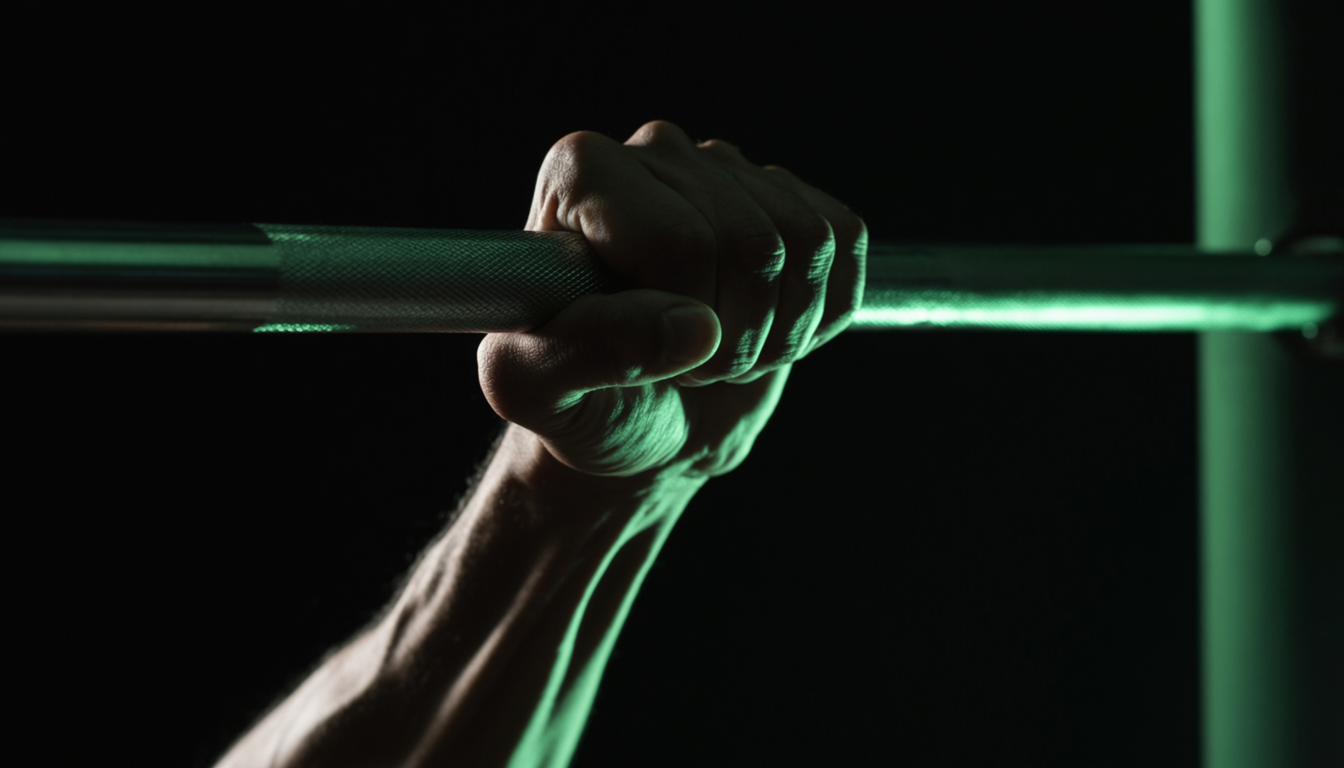
When a doctor checks your risk of an early death, they reach for the obvious numbers: blood pressure, cholesterol, blood sugar. They almost never reach for your hand.
That’s the mistake a decade of evidence has quietly corrected. Grip strength is not a party trick. It is one of the strongest, cheapest, most repeatable predictors of how long you’ll stay alive and independent — and, in the largest study ever done on it, a stronger predictor of cardiovascular death than systolic blood pressure.
Most men over 40 train their chest, their back, their legs. The muscle that predicts their lifespan most reliably? They leave it to carry their groceries.
What Your Grip Actually Measures
Grip strength is never really about your hand. The muscles of the forearm are the visible proxy for something bigger: your total neuromuscular function, your total muscle mass, and the biological wear on both.
Squeeze a dynamometer and you’re not reporting on your fingers. You’re leaking a readout of how much contractile tissue you carry across your whole body, and how well your nervous system still commands it. That’s why a weak grip correlates with frailty, slow walking speed, and a shrinking reserve of muscle — long before you’d notice any of those on your own.
The Number That Should Reset Your Training
The landmark study is the Prospective Urban Rural Epidemiology (PURE) study, published in The Lancet in 2015. It tracked 139,691 adults aged 35–70 across 17 countries for a median of four years, measuring grip with a simple hand dynamometer.
The finding, adjusted for age, activity, BMI, and more:
- Every 5 kg drop in grip strength → +16% risk of all-cause death, +17% risk of cardiovascular death.
- The same 5 kg drop also raised stroke risk 9% and heart-attack risk 7%.
- Grip strength was a stronger predictor of all-cause and cardiovascular mortality than systolic blood pressure — the “gold standard” number your doctor treats.
- Being in the lowest grip quartile (vs. the highest) more than doubled cardiovascular death risk.
Read that last line twice. A 40-something man’s grip — measured in five seconds with a $20 device — tells you more about his cardiovascular future than the number on the cuff.
It’s Not Just Your Heart
The same signal shows up in the brain. In the UK Biobank — nearly half a million adults — researchers looked at grip strength and dementia risk. Weaker grip and slower walking pace independently predicted new-onset dementia, even after accounting for age and the APOE gene that raises Alzheimer’s risk.
A separate UK Biobank analysis of 40,000+ people found greater grip strength linked to better cognition, higher life satisfaction, and fewer depression and anxiety symptoms. And a 2026 GeroScience paper went further: grip strength modified the connection between blood-based Alzheimer’s biomarkers and actual cognitive function — meaning stronger people with the same pathology lost less function.
The pattern holds in both directions you’d care about for a decade-long horizon: grip tracks your heart and your head.
The Threshold Worth Knowing — and Why One Number Isn’t Enough
There’s a clinical line here, not just a vague “stronger is better.” The EWGSOP2 — the European consensus on sarcopenia — flags grip below 27 kg in men (16 kg in women) as “probable sarcopenia”: the point where age-related muscle loss becomes a diagnosable problem, not a cosmetic one.
But 27 kg is a European threshold, and the Asian Working Group for Sarcopenia (AWGS) publishes stricter, age-specific numbers — which matter if you’re Asian, and matter more than most people realise if you’re in your fifties:
| Age | Men | Women |
|---|---|---|
| 50–64 | < 34 kg | < 20 kg |
| ≥ 65 | < 28 kg | < 18 kg |
Two things follow, and they pull in opposite directions.
The good news: EWGSOP2’s flat 27 kg is not the right line for a 50-something. A European man in his fifties is judged against a threshold built for older adults, and the AWGS 2025 update moved the other way — it lowered nothing for the 65+ group but raised the bar substantially for 50–64, because muscle strength declines well before 65.
The uncomfortable part: read against the stricter age-specific cut-off, a man in his early fifties closing 31 kg is below the line — where the flat 27 kg reading would have reassured him. That gap is exactly why the site gives you the numbers rather than a slogan.
You don’t need to obsess over the figure. But if a man in his fifties can’t reliably close 34 kg on a hand dynamometer, that’s not a training preference — it’s a signal the rest of his plan isn’t answering. Get one measurement before you decide you’re fine.
⚠️ Which threshold applies to you is a clinical call, not a blog’s. The two consensuses disagree on cut-offs and on which populations they were derived from, and neither is a diagnosis. If a number here worries you, take it to a doctor rather than to a training programme.
How to Build It (Hint: Not Wrist Curls)
Here’s the good news, and the reason this belongs in a decade-scale plan: grip responds fast, and it barely costs you training time.
- Dead-hang from a bar. Start at 20–30 seconds, build toward 60+. Grip, shoulders, and spine in one zero-equipment movement.
- Carry things. Farmer’s walks — hold two heavy dumbbells and walk. This is the single highest-ROI grip builder, and it doubles as core and posture work.
- Lift without straps. Deadlifts, rows, and pull-downs all want to be strapped. Skip the straps on your warm-up and lighter sets and let your grip earn the heavy ones.
- Squeeze your last rep. On every pulling movement, hold the top of the final rep for a hard 3 seconds. Cumulative, free, and it fuses grip work into lifts you’re already doing.
The trap to avoid is isolation theatre — endless wrist curls. Your grip isn’t weak in your wrist; it’s weak upstream in the big pulling and carrying you’ve been skipping. Train the carry, not the curl.
The Decade-Scale Point
Grip strength is a current reading of your future function. It declines first, it’s cheap to measure, and it’s the canary for whether your “get strong” plan is actually building the muscle that keeps you alive and independent — or just the muscle that looks right in a mirror.
For a man planning his next decade rather than his next six weeks, the message is simple: train the number that predicts your longevity, not the one that flatters your reflection.
Grip strength is the amount of force — but it’s only half the longevity signal. The other half, which fades even faster, is the speed of force: muscle power, the number your strength test misses.
But force is no use to a man who’s on the floor. Grip and power both assume you stay upright — balance is the system that decides whether you do, and it’s the sibling half of the same functional-independence picture: balance, the skill you regret not training. And if the reason your grip number is low is that sitting has quietly switched off your trunk, that’s the upstream cause, not a wrist problem: core strength for desk workers.
Your hands are holding more than the bar. They’re holding the first sign of whether the next ten years are yours.
Sources
- Leong DP, et al. Prognostic value of grip strength: findings from the Prospective Urban Rural Epidemiology (PURE) study. The Lancet. 2015;386(9990):266–273. — 139,691 adults, 17 countries; per 5 kg drop in grip, HR 1.16 all-cause and 1.17 cardiovascular mortality; strongest predictor vs. systolic BP.
- Cruz-Jentoft AJ, et al. Sarcopenia: revised European consensus on definition and diagnosis (EWGSOP2). Age and Ageing. 2019. — probable sarcopenia threshold: grip <27 kg men / <16 kg women.
- Chen LK, et al. Asian Working Group for Sarcopenia: 2025 consensus update. Geriatrics & Gerontology International. 2025 (doi:10.1111/ggi.70815 / agm2.70082). — age-stratified low-grip cut-offs: 50–64 yrs <34 kg men / <20 kg women; ≥65 yrs <28 kg men / <18 kg women. Interpretation: Jianghan et al., Aging Medicine 2026 (doi:10.1002/agm2.70082).
- Transition between 2019 and 2025 sarcopenia definitions by the AWGS in community-dwelling older adults. BMC Geriatrics. 2026 (doi:10.1186/s12877-026-07849-1), n=2,456. — age-specific cut-offs applied; sarcopenia prevalence 18.1% (2019 criteria) → 28.3% (2025 criteria), p<0.001.
- Walking pace, handgrip strength, age, APOE genotypes, and new-onset dementia: the UK Biobank prospective cohort study. Alzheimer’s Research & Therapy. 2022;14:158. — n=495,700; grip + walking pace independently predict dementia.
- Jiang R, et al. Associations between grip strength, brain structure, and mental health in >40,000 participants from the UK Biobank. BMC Medicine. 2022;20:262. — greater grip linked to better cognition, well-being, lower depression/anxiety.
- Grip strength modifies the association between blood-based Alzheimer’s biomarkers and cognitive function. GeroScience. 2026. — strength moderates the cognitive impact of neuropathology.